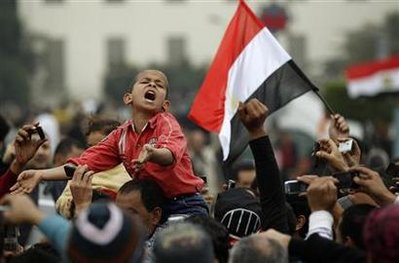
Egyptians have theatrical one of their main complaint yet insisting President Hosni Mubarak step down right away and pay no attention to a government plan to move power. For numerous protesters it was the first time they had united the daily exhibitions in Cairo's Tahrir Square showing the lobby group, now in its third week, still has drive.
A lot of said they were inspired by a Google executive's in tears televised account of his imprisonment by refuge forces.
Mubarak has say no to step down, but said neither he nor his son will stand for president in polls due in September. Vice President Omar Suleiman, who has been holding talks with resistance groups, said there was now a road map to hand over power, other than activist were indifferent by the plan.
Full Story
useful links:
transport rankings
 The Obama management is in talks with top Egyptian officials about the possible instantaneous acquiescence of President Hosni Mubarak and the configuration of an interim government that could get ready the country for free and fair ballot votes later this year, U.S. officials said late Thursday.
Formation of a military-backed concierge government in Egypt is one of more than a few ideas being conversed as anti-Mubarak protests rise in the streets of Cairo and other Egyptian cities, the officials said. Those protests are predictable to grow in size and strength on Friday and the administration fears they may go off into more widespread fighting unless the government takes physical steps to address the protesters' main order that Mubarak depart office.
The officials stressed out the United States isn't seeking to enforce a solution on Egypt save for noted that the administration had made a ruling that Mubarak has to go rapidly if there is to be a passive declaration to the crisis. The officials spoke on form of anonymity to talk about the susceptible diplomatic talks, which are continuing. The talks regarding Mubarak's immediate going away were first report by The New York Times.
Full Story
useful links:
transport rankings
 Threatening gangs backing President Hosni Mubarak attacked the media and human rights activists Thursday in an ugly twist in Egypt's crisis as government opponents pressed supporters out of Cairo's main square in a second day of road battles. Organizers called for activists trying to topple the regime to fill every four-sided figure in the huge assets on Friday.
The new vice president widely careful the first successor Mubarak has ever designated fueled anti-foreign feeling by going on state TV and blaming outsiders for fomenting strife. The government has accuse media outlets of being concerned to protesters who want the president to relinquish now rather than hand out out his term, as he has vowed to do.
The Obama administration, for now, was in talks with top Egyptian officials in relation to the prospect of Mubarak directly away resigning and the formation of an intervening government that could organize the country for free and fair elections later this year, U.S. officials said Thursday. The talks were first account by The New York Times.
Full Story
useful links:
transport rankings
 Heavy habitual weapons fire crushed the anti-government protest camp in Cairo's Tahrir Square before dawn on Thursday in a dramatic appreciation of what come into view to be a well-orchestrated series of attacks on the protesters. At least three protesters were killed by gunfire, according to one of the activists.
The crowds looking for an end to President Hosni Mubarak's nearly three decades in power were motionless reeling from attacks hours’ former in which Mubarak supporters charged into the quadrangle on horses and camels, pouring people with whips, while others rained firebombs and rocks from rooftops.
The strikers accuse Mubarak's regime of unleash a force of paid thugs and plainclothes Egypt police to squash their unparalleled nine-day-old movement, a day after the 82-year-old president refused to step down. They showed off police ID badges they said were wrested from their attackers. A number of government workers said their employers prearranged them into the streets.
Full Story
useful links:
transport rankings
 As accumulation demonstrations carry on to intimidate Egyptian president Hosni Mubarak's grip on power, the country's influential military is rising as possibly the crucial player in influential the course of events in the Middle East's most crowded nation.
By now, the army which has long enjoyed close ties to the ruling command is playing a key role in the efforts of the beleaguered Mubarak regime to control the growing chaos. More than the weekend, after police withdrew, the army deployed to cities across Egypt, keeping sort but usually not forcing protesters from the streets.
Today, the Egyptian government traditional permission from Israel to move soldiers into the Sinai Peninsula, which has been principally demilitarized since a 1979 peace contract between the two countries. And Mubarak has now curved to three career military men -- including Omar Suleiman, a former army widespread and head of the cunning services, now chosen vice president -- to help run the government.
Full Story
useful links:
transport rankings